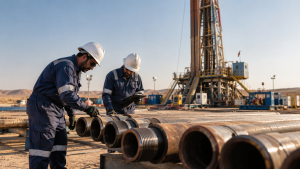

Crane certification and inspection services in Libya help oil and gas companies, drilling contractors, construction companies, and industrial operators keep cranes and lifting equipment safe and ready for work. A professional inspection checks the condition of the crane, lifting parts, safety devices, and related equipment. It can also include testing and certification based on the equipment type, applicable requirements, and inspection scope.
For companies working in Libya’s oilfield and industrial sectors, choosing a qualified inspection company is important. Eiger Engineering & Oilfield Services (EEOS) provides inspection, testing, certification, and oilfield technical services, including lifting equipment inspection for rig-based and mobile equipment.
What Is Crane Certification and Inspection?
Crane inspection is the process of checking a crane to find damage, wear, corrosion, cracks, deformation, or other conditions that could affect safe operation.
Crane certification provides documented evidence of the inspection and its results. The exact requirements depend on the crane type, manufacturer instructions, applicable standards, local requirements, and the intended use of the equipment.
Why Is Crane Inspection Important in Libya?
Cranes often work with heavy loads and under difficult conditions. Oilfield equipment may also face dust, corrosion, vibration, repeated loading, and long operating hours.
A regular Crane Inspection helps companies find problems before they become major equipment failures.
Main Benefits of Regular Crane Inspection
- Helps identify damaged or worn components.
- Supports safer lifting operations.
- Helps reduce unexpected equipment failure.
- Supports maintenance planning.
- Provides useful inspection records.
- Helps companies meet applicable client and industry requirements.
- Improves confidence in equipment before critical lifting work.
EEOS states that its inspection services are designed to support safety, reliability, compliance, and operational performance across oilfield and industrial operations.
What Does a Crane Inspection Check?
A professional inspection does not only look at the outside of a crane. The inspector considers the equipment’s condition and the safety-critical parts that are relevant to its use.
| Inspection Area | What May Be Checked |
|---|---|
| Structure | Cracks, corrosion, deformation, damage and general condition |
| Wire rope | Wear, broken wires, corrosion, deformation and condition |
| Hooks | Damage, deformation, wear and safety condition |
| Brakes | Operation and condition where applicable |
| Sheaves and drums | Wear, damage and alignment |
| Safety devices | Relevant limit and safety systems |
| Lifting accessories | Slings, shackles, beams and other connected equipment |
| Documentation | Identification, inspection history and relevant records |
Lifting Equipment Inspection in Libya
Crane safety cannot be separated from the other equipment used during lifting. A crane may be in good condition, but a damaged sling, shackle, hook, or lifting beam can still create a serious risk.
That is why Lifting Equipment Inspection should cover the complete lifting system where required.
EEOS lists inspection of rig-based and mobile lifting equipment, including:
- Slings and shackles
- Eye bolts
- Manual hoists
- Chain blocks
- Forklifts
- Mobile cranes
- Overhead traveling cranes
- MEWPs such as scissor lifts and boom lifts
- Turnbuckles
- Safety harnesses
- Trolleys
The company states that its lifting equipment inspection work is performed with reference to API RP 8B, LOLER, and local authority requirements. The applicable requirement should always be confirmed for the specific equipment and project.
Crane Inspection vs. Lifting Equipment Inspection
These terms are related, but they do not mean exactly the same thing.
| Crane Inspection | Lifting Equipment Inspection |
|---|---|
| Focuses on cranes and their components. | Covers a wider range of lifting equipment. |
| May include structure, hooks, ropes, brakes and safety devices. | May include cranes, hoists, slings, shackles, forklifts and MEWPs. |
| Used for crane safety and equipment condition. | Used to assess the wider lifting system. |
| Scope depends on crane type and requirements. | Scope depends on the equipment and lifting application. |
What About Lifting Gear and Accessories?
Small lifting components can carry large loads. For this reason, companies should not focus only on the crane itself.
A complete Lifting Gear Inspection may include the components used to connect, support, or control a load.
Important Lifting Gear Checks
- Lifting Accessories Inspection for accessories used with lifting equipment.
- Wire Rope Inspection for signs of broken wires, wear, corrosion, or deformation.
- Shackle Inspection for body condition, pin condition, deformation, and identification.
- Lifting Beam Inspection for structural condition, connections, markings, and visible damage.
- Slings Inspection for cuts, abrasion, damage, wear, identification, and general condition.
EEOS specifically lists slings, shackles, eye bolts, turnbuckles, and other lifting equipment within its inspection scope.
Are Load Testing Services Part of Crane Certification?
Load Testing Services may be required as part of an inspection or certification program, depending on the equipment, applicable requirements, manufacturer instructions, client specifications, or inspection procedure.
Load testing should not be viewed as a replacement for inspection. A safe lifting program may require several types of checks.
| Activity | Main Purpose |
|---|---|
| Visual inspection | Find visible damage, wear and corrosion. |
| Functional check | Confirm relevant equipment functions. |
| NDT | Help identify certain surface or internal defects without damaging the component. |
| Load testing | Verify performance under a defined test load when required. |
| Documentation review | Check equipment identity, history and relevant records. |
EEOS also provides NDT inspection services, including ultrasonic testing, magnetic particle testing, dye penetrant testing, and visual inspection.
Hoisting Equipment Inspection for Oilfield Operations
Oilfield operations use many types of hoisting and lifting systems. These systems need to remain in good condition because they may handle heavy loads during drilling, maintenance, rig moves, and equipment handling.
Hoisting Equipment Inspection can help operators assess the condition of relevant hoisting components and identify issues that require further action.
Similarly, Lifting Machinery Inspection can cover machinery used to lift, move, or position loads. The exact inspection scope should be based on the equipment and its intended use.
API RP 8B is an important reference for inspection, maintenance, repair, and remanufacture of hoisting equipment used in oilfield operations.
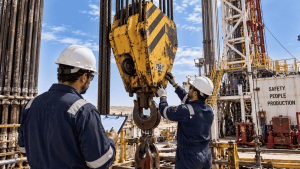
Oilfield Lifting Equipment Inspection
Oilfield Lifting Equipment Inspection is especially important because oilfield equipment often works in demanding environments.
Drilling contractors and operators may use:
- Mobile cranes
- Overhead cranes
- Manual hoists
- Chain blocks
- Slings
- Shackles
- Hooks
- MEWPs
- Other lifting accessories
Each item can have different inspection requirements. A competent inspector should therefore determine the correct scope instead of using the same checklist for every type of equipment.
Rig Lifting Equipment Inspection
Rig Lifting Equipment Inspection is important for drilling contractors because lifting systems are closely connected with rig safety and operational readiness.
EEOS also provides rig inspection services covering equipment integrity, structural inspections, NDT methods, and API-related inspection requirements.
Its wider rig inspection scope includes equipment such as traveling blocks, hooks, elevators, links, slips, bushings, manual tongs, and other critical rig components.
Man Riding Equipment Inspection
Equipment used to lift people needs special attention because the consequences of equipment failure can be severe.
Man Riding Equipment Inspection should consider the equipment design, safety-critical components, manufacturer instructions, applicable regulations, and the conditions in which the equipment will be used.
Companies should never assume that an inspection requirement for ordinary load lifting automatically applies to equipment used for personnel lifting.
Which Standards Are Used for Lifting Equipment Inspection?
The correct standard depends on the equipment and the inspection scope. EEOS states that its lifting equipment inspections are carried out with reference to API RP 8B, LOLER, and local authority regulations.
Its Quality Policy also states that the company’s documented quality management system meets the requirements of API Q2 Specification 2nd edition and that applicable regulatory, industry, and customer requirements are considered.
| Reference | Why It May Matter |
|---|---|
| API RP 8B | Inspection, maintenance, repair and remanufacture of hoisting equipment. |
| LOLER | UK lifting-equipment regulatory framework covering safe use and thorough examination. |
| Local requirements | Requirements that apply to the equipment and operation in Libya. |
| Manufacturer requirements | Equipment-specific instructions, limits and maintenance information. |
| Client requirements | Project-specific inspection and documentation needs. |
Important: International standards should not automatically be treated as Libyan law. The applicable legal and contractual requirements should be confirmed for each project.
How Does the Crane Inspection Process Work?
A simple inspection workflow can help companies understand what happens before a crane receives its inspection documentation.
- Equipment identification: The inspector confirms the equipment type, identification, capacity, and available records.
- Visual examination: The crane and relevant components are checked for visible defects.
- Component inspection: Safety-critical components are examined according to the inspection scope.
- NDT when required: Suitable NDT methods may be used to investigate specific areas.
- Functional checks: Relevant operating and safety functions are checked where applicable.
- Load testing when required: A controlled test may be performed according to the applicable procedure.
- Findings are recorded: Defects, observations, measurements, and recommendations are documented.
- Report or certification: The inspection result is documented according to the applicable scope.
Crane Inspection Checklist for Companies in Libya
Before an inspection, companies can prepare the following information:
- Equipment identification number
- Manufacturer information
- Rated capacity information
- Previous inspection certificate
- Previous inspection reports
- Maintenance records
- Load charts where applicable
- Known defects or repair history
- Location of the equipment
- Intended lifting application
- Client or project requirements
Good records help the inspector understand the equipment history and make the inspection process more efficient.
Why Choose EEOS for Crane Inspection in Libya?
EEOS combines local oilfield knowledge with internationally recognized inspection practices. The company states that its team includes certified NDT inspectors, QA/QC coordinators, rig safety experts, lifting gear engineers, and API compliance advisors.
EEOS also highlights field-ready mobile inspection units, paperless reports, digital traceability, and a broad equipment scope.
According to the company’s Certification & Membership page, EEOS is a member of the International Association of Drilling Contractors (IADC) and states that it was the first company in Libya to achieve API Spec Q2 registration.
EEOS was founded by oilfield professionals with more than 40 years of combined experience, according to its About Us page.
Why Is Professional Inspection Better Than a Basic Visual Check?
A basic visual check can find obvious problems, but it may not be enough for every piece of lifting equipment.
| Basic Check | Professional Inspection |
|---|---|
| Usually focuses on visible condition. | Uses a defined inspection scope. |
| May be performed as part of daily operations. | Performed by competent inspection personnel. |
| May not include NDT. | NDT can be included where required. |
| Limited documentation. | Detailed inspection findings can be recorded. |
| Not normally a certification activity. | Can support formal inspection reporting or certification. |
Conclusion
Crane certification and inspection services in Libya are an important part of safe lifting operations in oil and gas, drilling, construction, and industrial environments. A complete inspection program should look beyond the crane itself and consider the lifting equipment, accessories, hoisting systems, and supporting documentation.
From Crane Inspection and Load Testing Services to Wire Rope Inspection, Shackle Inspection, and Slings Inspection, the right inspection scope depends on the equipment and the work it performs.
For companies that need professional inspection and certification support in Libya, contact EEOS to discuss your equipment, site location, inspection requirements, and certification needs.
Frequently Asked Questions
How often should a crane be inspected in Libya?
The inspection frequency depends on the equipment, operating conditions, manufacturer requirements, applicable regulations, inspection scheme, and client requirements. A competent inspection provider should determine the appropriate examination schedule.
What equipment can be included in lifting equipment inspection?
Depending on the scope, inspection can include cranes, forklifts, hoists, chain blocks, slings, shackles, wire ropes, lifting beams, MEWPs, and other lifting accessories.
Is load testing required for every crane?
No. The need for load testing depends on the equipment, applicable requirements, manufacturer instructions, client specifications, and inspection procedure.
What is the difference between crane inspection and crane certification?
Crane inspection is the examination of the equipment and its relevant components. Crane certification is the documented result or certificate issued according to the applicable inspection scope and requirements.
Can EEOS inspect lifting equipment at an oilfield or rig?
Yes. EEOS provides lifting equipment inspection for rig-based and mobile equipment and supports oilfield inspection activities in Libya.
Why are slings and shackles inspected separately?
Slings and shackles are safety-critical parts of a lifting system. A crane can be in good condition while an attached accessory is damaged, worn, deformed, or unsuitable for use.